

Latest News

Instrument Marking in Healthcare: Why Traceability Is a Patient Safety Priority
May 2026
As NHS Trusts move toward single instrument traceability, the marking method you choose matters more than ever. Permanent laser marking delivers lifetime traceability without compromising infection control - and Sciamed has been helping healthcare organisations get it right for over 30 years.
When we talk to Sterile Service teams across the NHS, one concern comes up time and again: how do you maintain reliable traceability on surgical instruments that are sterilised hundreds of times over their lifetime?
It’s a fair question. Instrument marking is often treated as a purely operational decision, but in practice, it plays a direct role in traceability, infection control, and quality assurance. Get it right, and you have a system you can trust. Get it wrong, and the risks are real.
Every Instrument Tells a Story. If You Can Read It
Accurate identification is fundamental to safe clinical practice. Across the NHS, barcode and tracking systems already link patients to treatment records, track specimens and medication, and reduce the risk of human error. The same principle applies to surgical instruments.
When an instrument can be reliably traced, every item is correctly identified and accounted for at every stage of the process. But when traceability breaks down, the consequences can be serious: the instrument’s history becomes unclear, its use cannot be confidently verified, and compliance becomes difficult to demonstrate.
In high-risk clinical scenarios, that’s not just an operational headache — it’s a patient safety concern.
Labels, Dots, and Other Temporary Fixes
Many hospitals still rely on external marking methods such as adhesive labels. These can work well initially, but they introduce uncertainty over time. Labels wear, scratch, and even detach during repeated sterilisation cycles. Edges lift, creating areas where contamination can accumulate. And once a label is lost, traceability is immediately compromised.
Other methods, such as dot peen marking, create physical indentations in the instrument’s surface. While more durable, these marks can disrupt the protective layer of stainless steel and introduce microscopic areas where bacteria may persist.
In both cases, the question isn’t just about durability. It’s about whether the marking method supports or undermines your infection control and traceability standards.
Permanent Marking That Doesn’t Compromise the Instrument
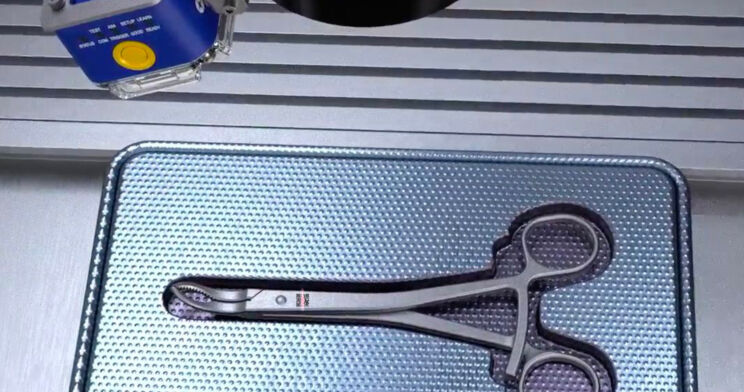
This is where laser marking offers a fundamentally different approach. Rather than adding a label or physically indenting the surface, it uses a controlled beam of light to create a permanent mark within the material itself. Nothing is added. Nothing is removed. The mark becomes part of the instrument.
For healthcare environments, that matters in several important ways.
Consistent, Lifetime Traceability
Because the mark is part of the instrument, it cannot be removed, degraded, or lost. Traceability is maintained throughout the entire lifecycle — including after repair or refurbishment. That means no relabelling, no re-scanning, and no gaps in your records.
No Additional Infection Risk
As a non-contact process, laser marking doesn’t create grooves, adhesives, or raised edges. The instrument surface remains smooth, supporting effective cleaning and sterilisation every time.
Protection of Instrument Integrity
Using short-pulse laser technology (such as DPSS), markings are applied cleanly and precisely without overheating or damaging the material. This avoids the risk of corrosion or pitting that more aggressive methods can cause.
Improved Quality Control
Permanent identification allows instruments to be linked to specific sets and tracked accurately over time, making it easier to identify instruments that have moved between sets, maintain set integrity, and detect issues before they impact patient care.
Built for the Demands of Modern Healthcare
Healthcare systems are under increasing pressure to deliver greater accuracy, accountability, and efficiency. Technology plays a key role in achieving this, particularly when it reduces reliance on manual processes and removes opportunities for error.
The most effective instrument tracking solutions are those that maintain accuracy without additional intervention, withstand demanding sterilisation environments, and support compliance without adding complexity. Permanent laser marking meets all three requirements by ensuring that traceability doesn’t depend on something that can fail over time.
Raising the Standard With a Partner You Can Trust
As expectations around patient safety and quality control continue to rise, so too must the systems that support them. Instrument marking is no longer just about identification, it’s about ensuring full lifecycle traceability, supporting infection prevention, and providing confidence at every stage of care.
At Sciamed, we’ve been helping NHS and healthcare organisations with instrument marking and traceability solutions for over 30 years. We understand the pressures sterile services teams face, and we’re here to help you find the right approach for your setting.
Ready to explore permanent instrument marking for your organisation? Our laser marking specialist is here to help. Contact our team at 01975 564111 or email sales@sciamed.co.uk to arrange a consultation.
For more information, call
01975 564111
or email sales@sciamed.co.uk

August 2026
What's New in BarTender 12: Cloud and On-Premise in One System
For years, labelling software has forced a choice: keep everything on-premise for control and compliance,…

July 2026
7 Questions to ask before investing in a laser marking system
With UDI compliance becoming a global requirement, more Sterile Services Departments are evaluating laser…

July 2026
The Hidden Cost of Unlabelled or Mislabelled Library Assets
For collections managers, librarians and institutional procurement teams Every library has them. The…